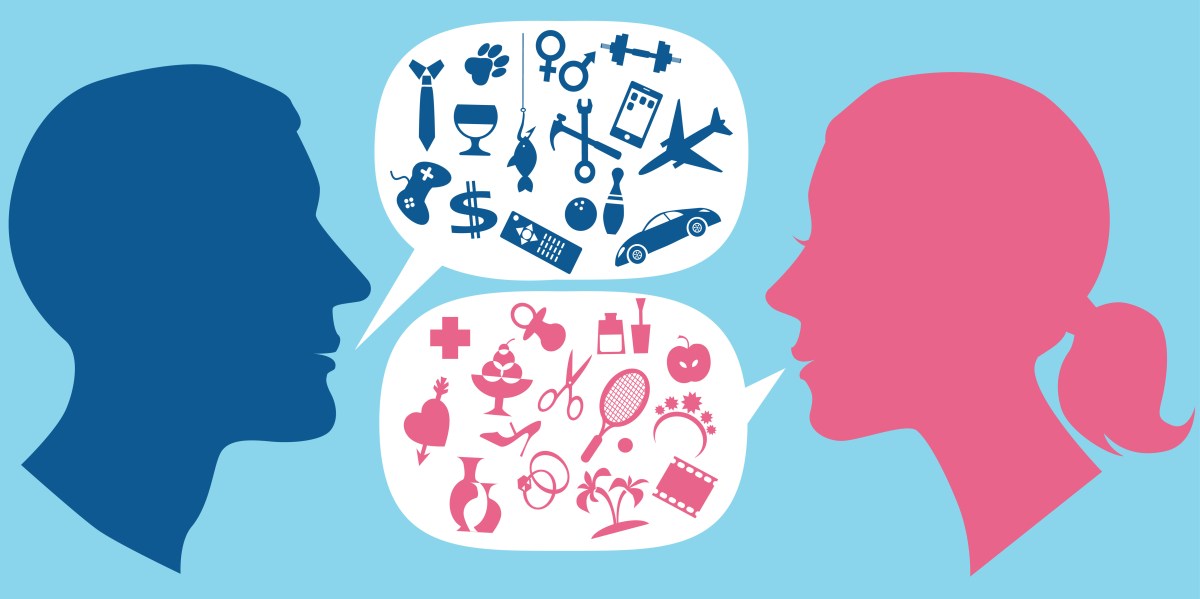
I just realized something, and while it may be immediately shocking or offensive to some people, it is something that must be understood, and once understood, beneficial to the society in which we participate.
In most cases, we as people, are not really attracted to another’s “sex”, but rather to a person’s gender, and all that gender encompasses.
Before understanding my argument, you must first understand the difference between sex and gender.
Sex is a person’s physical, biological dichotomy of male or female (the sexual genitalia one has, their hormones, etc.) while gender is its associated social, psychological, and cultural constructs – everything society ascribes to a person’s sex. Sex is identical universally to all humans, but gender varies greatly across every society.
Generally, there is one gender ascribed to each sex, but they are not the same. Our reason to polarize gender is influenced by the sex. The biological continuum of genes, chromosomes, hormones, and reproductive physiology helps produce a script for appearing and behaving male or female. However, each society’s gender expectations have developed very differently, with no one society’s attributions to each sex being right or wrong, or better than another.
Men and women have different acceptable appearances, roles, and ways of acting in each society and what is acceptable in one society may be unthought of in another. For example, men wear skirts (called kilts) in Scotland, and on Valentine’s Day, women buy chocolates for men in Japan. At birth in Belgium, boys are put in pink and girls in blue. There, pink is considered masculine and strong, and blue is considered feminine and dainty. In part of South Vietnam, society is matriarchal (female-dominated), not patriarchal (male-dominated). The list goes on.
So moving forward, knowing that a male in one culture may look opposite to a male in another, we consider what makes one attractive.
One sex will always be sexually attracted to the other in all current societies (otherwise these societies would cease to exist, due to a lack of heterosexual procreation). But the way each gender (including physical appearance) looks in each country may be radically different. However, even with these differences, the male is still attracted to the female! Even if the male in another society appeared to us Americans as female, the females there are attracted to him. And vice-versa. What is found attractive in one society is entirely different in another.
So why is this, if the sexes are the same across cultures? Because attraction is based on society-ascribed gender, and not sex. Gender, including physical appearance, changes by the culture, and becomes normalized there. Thus, the society’s own physical and mental attractions adapt and normalize that, as well. What looks like male and female in the United States may look very different in Syria or Japan.
To prove my point, one can be attracted to a trans-gender woman (not knowing it was a male) because they choose to embody the physical appearance expected for the female gender (not their sex). The reason it’s gender, is because if it were tied only to a person’s physical sex, then they would not be able to cross over genders and appear as the other gender in the first place. So gender is not necessarily physically based, but based rather on the role and appearance an individual chooses to embody.
Most of the time, we don’t actually know what a person’s sex is unless we see their genitalia, so we make assumptions based on their appearance (gender-based). Which is why, for example, being trans-gender, or cross-dressing, and being able to appear as the opposite sex, is even possible in the first place. Generally, all they have to do to “pass” as the other sex, is act and alter their appearance to appear as the gender society ascribes to the opposite sex. (I know there are other more complex things involved, but this covers the majority of it).
Therefore, because we can’t know one’s actual sex from first impressions, but determine it based on a person’s chosen (yes, mostly chosen) physical appearance and other gender-based attributes – we are, at least immediately, attracted to their gender (expressed by their clothing, physical appearance, and mannerisms), not their sex. In our society, physical appearance and other roles are, while somewhat ingrained, more largely taught since birth, from the moment the parent puts blue or pink on the newborn.
Much of an American woman’s appearance, for example, is based on things learned, not ingrained. To be accepted as a healthy heterosexual woman in American society, she must dress a certain way, keep her hair a certain length, and behave in a way supposedly “natural” for others who share her sex. For a man, the gender boundaries are just as tight in other ways; he has much less leeway in terms of how he can dress, and if he crosses over boundaries women regularly do, he is seen as gay or immoral.
If women and men were truly taught by our society to look and act equally, and furthermore, taught that they are equal, there would be much less separating their appearance and the ways they act than you might think. And most of the ways people become attracted to another in the first place, is, again, not through physically seeing the other’s sex, but actually by seeing their gender, supposedly determining their sex, to be accepted as male or female within that society.
Once again, we are attracted to a person based on gender (not sex) because, knowing all that gender encompasses beyond physical attributes ingrained in either male or female, the reasons for attraction to another (largely physical appearance, ways of acting, personality), are largely societal-taught gender attributes any individual can be taught. If you can’t see a person’s sex (body parts), then you’re most certainly seeing their gender.
End Note:
These are just my observations. Obviously, there are still some innate physical differences that contribute to one’s physical appearance, due to sex, and may influence a male’s attraction to a woman, or vice versa (body only). But my point is that regardless of sex, a male can mostly alter his appearance to appear as a girl, and then be seen as a girl by our society, thus appearing female, sexually.
A physical sex change is not necessary to be seen as female, but a gender change, specifically taking up the role of female gender in appearance, is necessary. And vice-versa.
Therefore, we can only assume one’s sex by seeing the gender they practice, thus allowing us to feel attracted to them. We begin to feel attraction upon seeing the gender they practice, and we fill in the blanks from there.
P.S.
Of course, I do not mean to downplay the distinctions of gender. I do find coding sex by physical appearance acceptable and somewhat necessary.
Our society determines one’s sex based on their gender, so it does, for example, cause problems when one’s sex does not correspond to what the society teaches that the specific gender should reflect (trans-gender individuals may experience difficulty with this in search of serious partners, which is unfortunate.)
However, I believe that the range of restrictions, role and personality expectations, and lack of cross-fluidity placed on each gender in our society is unacceptable.
In my opinion, men should be able to dress more freely, adopting more feminine styles without judgment, be able to show more love to other men as heterosexuals, as women do among themselves, and not have to worry about “degrading himself” by expressing himself in ways seen as traditionally feminine, stepping away from the “masculine” rigidity we are taught to have today. And women should be able to appear as they want without judgment, be able to work the same job at the same pay as men, not be subject to harassment based on their sex, and be seen as social equals to men. Trans-gender people should have the right to use the restroom corresponding to their gender (because it is the one they look like after all). Each sex may even have ingrained differences – men may have more physical strength, but women quicker emotional processing. While they are not identical, men and women deserve to be treated as equal. After all, men and women’s ingrained differences complement each other, and in unity, a man and woman are capable of much more than any man or woman alone. And no man would exist without his mother who bore him initially. Man needs woman as much as woman needs man. So each deserves to be treated equally, embracing their strengths in unity, rather than oppressing each other in division.
History has made gender what it is today, and it is different in each society. In Ancient Greece, men wore corsets, and in Scotland, they wear kilts. The feminist movement in the U.S. has allowed us to see pants, formerly only men’s garments, become standard apparel for women. In many parts of the world, women hold dominance over men, not the other way around.
Countless historical or political reasons and popular culture have changed society’s fashion, values, and gender attributions many times before, making what was previously”unthinkable”, the standard. Thankfully, it is gradually changing, as men and women become more flexible in their gender roles, and more equal, as well. However, there is still work to be done. Whether it be a social movement, artists driving popular culture popularizing a trend, or a mass realization of the strictness and inequality of our society, we will move forward again.
To explore more on gender, check out the articles linked below.
Sources:
 Noah Sanchez